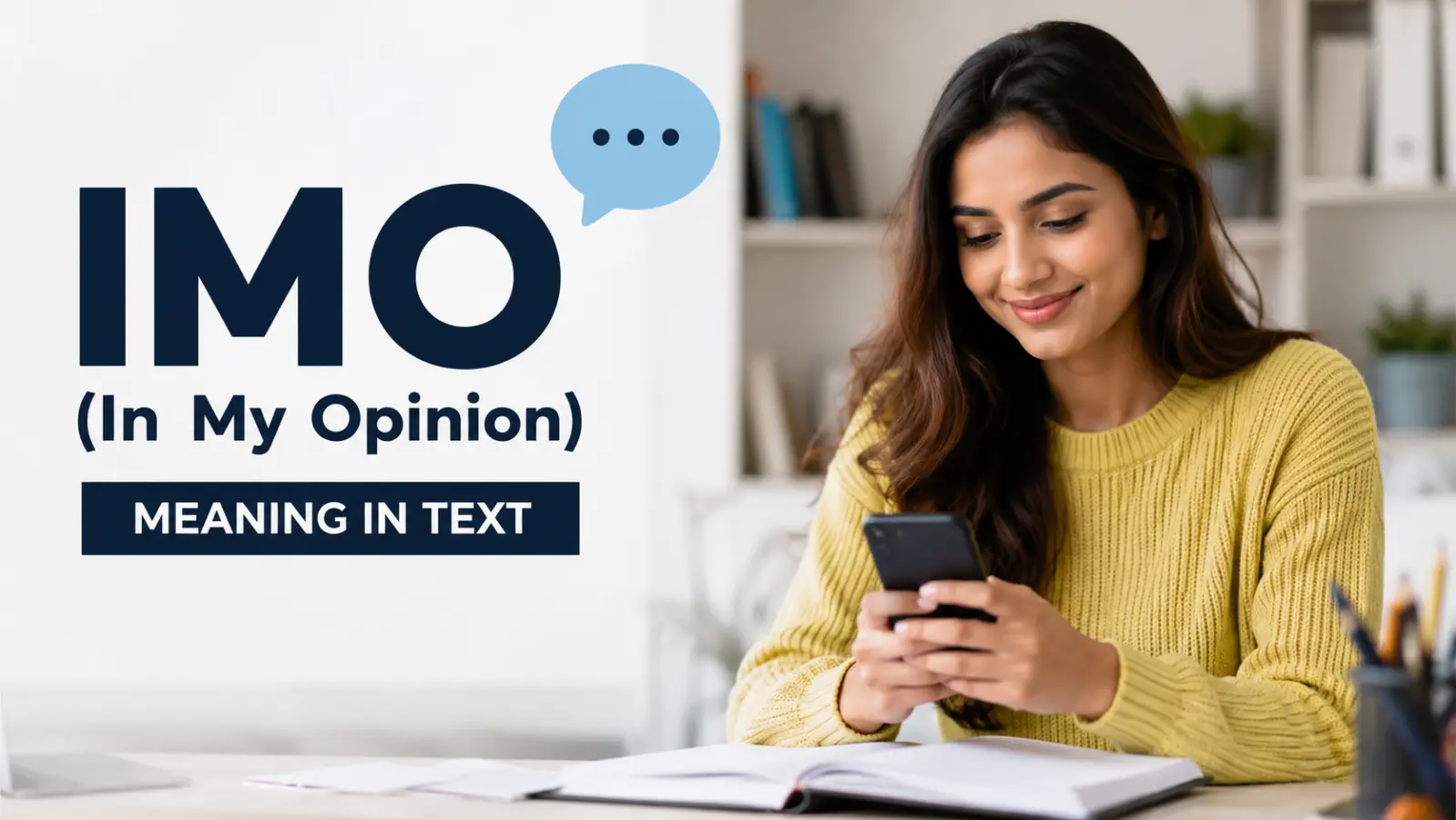
IMO Meaning in Text is one of the most searched internet slang terms because people often come across it in text messages, social media posts, online forums, and chat conversations. If you’ve ever seen someone write “IMO” and wondered what it means, you’re not alone.
Online communication has created countless abbreviations that make conversations faster and more convenient. Among these, IMO is one of the most popular because it helps people express opinions without sounding overly forceful.
Whether you’re chatting with friends, commenting on a social media post, or participating in an online discussion, understanding IMO can help you communicate more effectively and understand others better.
Quick Answer
IMO stands for “In My Opinion.” It is used to express a personal view or belief while making it clear that the statement is subjective and not necessarily a fact.
What does imo meaning in text mean?
The phrase imo meaning in text refers to the abbreviation “imo,” which is used in digital conversations to share personal viewpoints. It is a shorthand way of saying “in my opinion,” helping users communicate more quickly while keeping the tone polite and subjective.
Instead of writing a long sentence like “In my opinion, this movie is great,” people simply write “imo, this movie is great.”
Full form of IMO
- IMO = In My Opinion
Simple definition
- A short form used in texting to express personal thoughts or beliefs.
Meaning in different contexts
The meaning of “imo” remains the same, but its tone can change depending on how and where it is used:
- Casual chats: Used to share friendly opinions
- Social media posts: Used to comment or give viewpoints
- Debates or discussions: Softens disagreement
- Professional informal settings: Used carefully to suggest ideas
For example:
- “imo, this design looks better.”
- “imo, we should try a different approach.”
Is it rude, offensive, or neutral?
The slang imo meaning in text is completely neutral. It is not rude or offensive. Instead, it is considered polite because it shows that the speaker is sharing a personal opinion rather than stating a fact.
However, tone matters. If used in a sarcastic or dismissive way, it may feel slightly critical, but the word itself is safe and respectful.
Where is it commonly used?
“imo” is widely used across digital platforms such as:
- WhatsApp chats
- Instagram comments
- Snapchat messages
- X (Twitter) replies
- Reddit discussions
- Online gaming chats
It is especially popular among teenagers, students, and professionals who prefer quick communication.
Real-life conversation examples
Friendly usage
- “imo, this restaurant has the best pizza in town.”
Casual usage
- “imo, you should watch that series, it’s really good.”
Argumentative usage
- “imo, your argument doesn’t consider all the facts.”
Different contexts
- “imo, we should postpone the meeting.”
- “imo, that update made the app worse.”
Emotional and psychological meaning
Using “imo” in conversations reflects emotional intelligence in communication. It shows that the speaker is:
- Respecting other people’s opinions
- Avoiding direct confrontation
- Expressing thoughts in a softer tone
- Encouraging healthy discussion
It helps reduce conflict and makes online communication more balanced.
Origin and background of the slang
The slang “imo” originated from early internet forums and chatrooms in the late 1990s and early 2000s. As online communication became faster and more informal, users started shortening common phrases like “in my opinion” to save time and effort.
Over time, it became widely accepted in internet culture and is now a standard part of online texting language.
Comparison with similar slang
| Slang | Full Form | Meaning | Usage Tone |
|---|---|---|---|
| imo | in my opinion | personal view | neutral |
| imho | in my humble opinion | polite opinion | softer |
| tbh | to be honest | honest opinion | direct |
| idk | I don’t know | uncertainty | neutral |
Among these, “imo” is the most commonly used for simple opinion sharing.
When to avoid using it and when to use it
Use “imo” when:
- Sharing personal thoughts
- Giving suggestions
- Participating in online discussions
- Expressing soft disagreement
Avoid “imo” when:
- Writing formal emails
- Submitting academic papers
- Communicating in strict professional reports
- Legal or official documents
Polite alternatives
If you want to avoid slang, you can use:
- “In my opinion”
- “I believe that”
- “From my perspective”
- “I think that”
These are more formal and suitable for professional communication.
Why people use this slang
People prefer using “imo” because:
- It saves time while typing
- It keeps conversations short and simple
- It makes opinions sound less harsh
- It is widely understood online
- It fits naturally in fast-paced digital chats
Impact of using slang in communication
Slang like “imo” has changed the way people communicate online. It has made conversations:
- Faster
- More casual
- More expressive
- Easier to understand in context
However, overuse in formal settings can reduce professionalism.
Is it safe for social media?
Yes, “imo” is completely safe for social media use. People widely accept IMO across platforms and do not associate it with any offensive meaning. Influencers, content creators, and brands also use it to share opinions casually.
Examples in different tones
Friendly
- “imo, this song is a masterpiece.”
Casual
- “imo, you should upgrade your phone.”
Argumentative
- “imo, you are missing the main point here.”
Professional informal
- “imo, this strategy needs improvement.”
Common misunderstandings
Some people think “imo” is rude or dismissive, but that is not true. The misunderstanding comes from tone, not meaning. It simply shows a personal opinion and nothing more.
Variations and types
- IMO (capital letters)
- imo (lowercase, most common)
- IMHO (slightly more polite version)
All versions mean almost the same thing.
How to respond when someone uses it
You can reply naturally depending on context:
- “I agree with your opinion.”
- “That’s interesting, I see it differently.”
- “Good point, imo too.”
Regional and cultural usage
“imo” is globally used and not limited to any specific country. It is especially common in:
- English-speaking countries
- Online gaming communities
- Social media users worldwide
Its simplicity makes it universal.
Comparison table: imo vs imho vs tbh
| Term | Meaning | Tone | Best Use |
|---|---|---|---|
| imo | in my opinion | neutral | general opinions |
| imho | in my humble opinion | polite | respectful discussions |
| tbh | to be honest | direct | honest feedback |
FAQs :
1. What does imo stand for in text?
It stands for “in my opinion.”
2. Is imo formal or informal?
It is informal and mainly used in digital communication.
3. Can imo be used in professional emails?
It is better to avoid it in formal writing.
4. Is imo rude?
No, it is neutral and polite.
5. What is the difference between imo and imho?
“Imho” is a more polite version meaning “in my humble opinion.”
6. Where is imo mostly used?
It is used in chats, social media, and online discussions.
Conclusion :
The imo meaning in text is simple: it stands for “in my opinion” and is used to share personal thoughts in a short, friendly way. It is one of the most common internet slang terms that helps make digital communication faster and more natural.
Understanding when and how to use “ imo” is important because context and tone matter. While you can use it perfectly in casual conversations, you should avoid it in formal writing. Overall, it is a safe, widely accepted, and useful slang that enhances online communication when used correctly.

I’m Amber Laughlin, a writer who lives to make words dance with humor and heart. I love creating clever puns and cheerful messages that brighten any day. My goal is to turn simple moments into smiles through playful writing. Every line I craft is meant to share laughter, warmth, and a little sparkle of joy.